
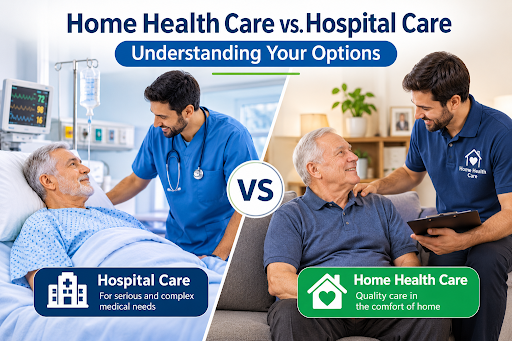


Choosing between home health care and hospital care can be challenging, especially when a loved one needs ongoing medical attention, assistance with daily activities, or support while recovering from an illness or surgery. Families often struggle to determine which setting offers the right balance of medical supervision, comfort, safety, and affordability.
Both options serve important purposes, but they are designed for different levels of care. Hospitals provide immediate medical treatment and intensive monitoring, while home health care allows eligible patients to receive certain medical services and recovery support in the familiar surroundings of their own homes. Understanding these differences can help families make informed decisions based on medical needs rather than assumptions.
The right choice depends on several factors, including the patient’s condition, recovery goals, level of independence, and the availability of professional caregivers. Knowing when each option is appropriate can also prevent unnecessary hospital stays and support a smoother recovery.
Understanding the Difference Between Home Health Care and Hospital Care
The most significant difference between home health care and hospital care is the environment in which treatment is provided and the level of medical supervision available.
Hospital care is designed for patients who require immediate medical attention, complex diagnostic procedures, surgery, or continuous monitoring. Hospitals have physicians, nurses, specialists, diagnostic equipment, and emergency resources available around the clock. This makes them essential for managing serious or unstable medical conditions.
Home health care, on the other hand, provides qualified medical services and assistance in a patient’s residence. Depending on eligibility and individual needs, services may include skilled nursing, physical therapy, occupational therapy, wound care, medication management, and recovery support.
For example, someone experiencing chest pain or severe breathing difficulties needs emergency hospital evaluation. However, a patient recovering from a hip replacement may benefit from prescribed physical therapy and nursing visits at home once their condition is stable.
Neither option is universally better. Each serves a different purpose within the healthcare system.
How to Decide Which Care Option Is Right
Selecting the appropriate care setting requires evaluating the patient’s medical condition, treatment requirements, and living circumstances. The following steps can help families make a practical decision.
1. Evaluate the Patient’s Medical Condition
Start by understanding the severity of the patient’s condition. People experiencing medical emergencies, severe infections, uncontrolled bleeding, major injuries, or serious breathing problems generally require hospital care.
Hospitals are also necessary when patients need procedures or treatments that cannot safely be provided at home.
However, patients with stable conditions may be able to receive certain treatments through home-based services. For instance, an older adult recovering from an infection may need nursing assessments and medication support after being discharged.
Always consult a qualified healthcare professional before changing the care setting.
2. Consider the Level of Medical Supervision Required
Some patients need constant observation, while others require only scheduled medical visits.
Hospital environments provide access to nursing staff and physicians throughout the day and night. This is particularly important when a patient’s condition could change unexpectedly.
Home-based services generally operate through scheduled visits rather than continuous medical supervision. Although some patients may arrange around-the-clock personal caregiving, this does not replace hospital-level monitoring.
Families should discuss the patient’s monitoring requirements with their physician before considering home recovery.
3. Assess the Home Environment
A patient’s home must be suitable for recovery. Important considerations include accessibility, cleanliness, available space, bathroom safety, and proximity to emergency services.
For example, someone recovering from knee surgery may need handrails, a shower chair, a walker, and a clear pathway between the bedroom and bathroom.
If the patient lives alone or has difficulty moving independently, additional caregiving arrangements may be necessary.
A healthcare professional or occupational therapist can help identify safety improvements before discharge.
4. Compare Treatment Costs and Insurance Coverage
Healthcare expenses can influence the decision, but families should compare the actual services included rather than relying on general assumptions.
Hospital costs may involve room charges, physician fees, diagnostic testing, medications, and procedures. Home health care expenses depend on the type, frequency, and duration of services.
Insurance coverage also varies. In the United States, Medicare may cover qualifying skilled home health services when specific eligibility requirements are met. However, it generally does not cover unlimited personal care or continuous custodial assistance when that is the only service required.
Families should verify coverage, deductibles, copayments, and provider eligibility before making financial commitments.
Key Benefits of Home Health Care and Hospital Care
Understanding the advantages of each setting makes it easier to match available services with a patient’s needs.
Benefits of Home Health Care
Comfort and familiarity: Recovering at home allows patients to remain in an environment they recognize. Familiar surroundings can reduce the stress associated with unfamiliar clinical settings.
Personalized attention: Scheduled visits allow healthcare professionals to focus on specific treatment goals, monitor progress, and communicate recommendations to family members.
Greater independence: Patients may continue participating in everyday activities while receiving appropriate support. This can help maintain confidence and functional abilities during recovery.
Family involvement: Relatives can participate in care planning, learn safe caregiving techniques, and better understand medication schedules and recovery requirements.
Reduced exposure to hospital environments: For eligible patients who no longer need inpatient treatment, home recovery can reduce exposure to healthcare-associated infections.
Benefits of Hospital Care
Immediate emergency treatment: Hospitals are equipped to respond to medical emergencies, sudden complications, and rapidly changing conditions.
Access to specialists: Patients can receive evaluations from different medical specialists without arranging separate appointments.
Advanced diagnostic facilities: Hospitals provide access to imaging, laboratory testing, surgical facilities, and specialized medical equipment.
Continuous monitoring: Patients with serious conditions can receive ongoing observation and timely medical intervention.
Coordinated treatment: Multiple healthcare professionals can work together to manage complex medical conditions and adjust treatment plans.
Common Mistakes Families Should Avoid
Choosing a care setting based on incomplete information can create unnecessary risks and complications.
One common mistake is assuming that home health care can replace hospital treatment. Home-based services are appropriate for many recovery situations, but they cannot provide every medical intervention. Delaying emergency treatment because a patient prefers staying home can have serious consequences.
Another mistake is underestimating the patient’s daily support requirements. Skilled nursing visits do not necessarily include meal preparation, housekeeping, bathing assistance, or continuous supervision. Families should clarify exactly which services are included.
Financial assumptions can also cause problems. Some families believe insurance will cover every home-based service, only to discover that certain forms of personal care are excluded. Confirming coverage beforehand helps avoid unexpected expenses.
Finally, families sometimes overlook caregiver fatigue. Relatives who provide daily assistance may experience physical and emotional exhaustion, particularly when caring for someone with limited mobility or memory difficulties. Professional support and realistic caregiving schedules can make a significant difference.
Practical Tips for Making the Right Decision
A thoughtful care plan should consider both medical recommendations and the patient’s everyday circumstances.
Here are several practical recommendations:
- Start with a medical assessment: Ask the treating physician whether the patient is medically stable enough to receive care outside a hospital.
- Request a discharge plan: Before leaving the hospital, understand medication instructions, follow-up appointments, warning signs, and recommended therapies.
- Identify specific care needs: Make a written list of required services, such as wound care, mobility assistance, medication management, or physical therapy.
- Prepare the home: Remove trip hazards, improve bathroom accessibility, arrange necessary medical equipment, and create a comfortable recovery space.
- Choose qualified providers: Verify professional credentials, licensing where applicable, experience, and the specific services offered.
- Maintain communication: Ensure family members, physicians, and home healthcare professionals understand the treatment plan.
- Monitor recovery: Keep track of symptoms, medication schedules, mobility improvements, and changes in the patient’s condition.
It is also important to recognize that care needs can change. A patient may begin treatment in a hospital, transition to home health services, and eventually require only occasional medical follow-ups.
For example, an older adult recovering from a stroke may initially need hospital treatment and rehabilitation. Once medically stable, prescribed therapy at home can help improve mobility, coordination, and independence. Regular assessments can determine whether additional support is necessary.
Conclusion
Home health care and hospital care are both essential parts of modern healthcare, but they address different patient needs. Hospitals are best suited for emergencies, complex procedures, and conditions requiring continuous medical supervision. Home health care offers an alternative for eligible patients who are medically stable but still need professional treatment and recovery assistance.
The best decision should always begin with a medical assessment and consider the patient’s safety, treatment requirements, home environment, financial circumstances, and personal preferences.
By understanding what each option offers, families can make more confident decisions, avoid unnecessary complications, and create a care plan that supports both recovery and quality of life.