
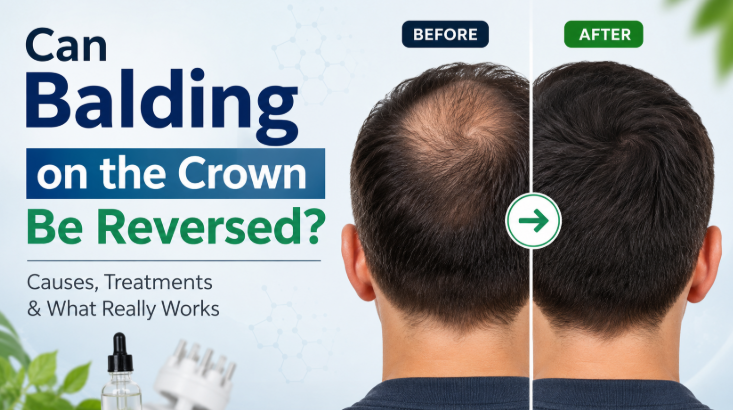


Hair loss is a multilayered problem affecting numerous people all around the world. It can present itself in different ways and degrees, yet among the most widespread types of hair thinning lies vertex alopecia, also known as balding of the crown. Being located at the top part of the head, the crown is one of the first places on which signs of androgenic alopecia start appearing, sometimes referred to as male/female pattern baldness. However, when a person starts noticing an expanding circle of hair thinning on the top of his/her head, the question arises: Is it possible to reverse balding of the crown?
Understanding the Mechanism of Crown Thinning
The primary driver behind hair loss at the crown is genetic predisposition combined with hormonal changes. Specifically, hair follicles in this region are genetically sensitive to a hormone known as dihydrotestosterone (DHT). Over time, exposure to DHT shortens the growth phase of the hair cycle, causing the follicles to produce thinner, shorter, and less visible hair strands. This gradual process continues until the follicles stop producing hair altogether.
Because the crown features a distinct circular growth pattern, thinning in this area can appear more pronounced compared to a receding hairline. Consequently, managing and reversing vertex hair loss requires an approach tailored to the unique characteristics of this scalp section.
Non-Surgical and Preventive Methods
In the early-to-moderate stages of crown thinning, several non-surgical options can effectively slow down or partially counteract the process. Medical science has introduced treatments that focus on either stimulating blood circulation or addressing the hormonal components of hair loss.
Topical solutions applied directly to the scalp are frequently utilized to enhance blood flow to the hair follicles. With consistent and long-term use, these treatments can help revitalize weakened hairs and encourage growth. Additionally, prescribed oral medications work by reducing system-wide levels of DHT, thereby preventing further follicle miniaturization.
While these preventive measures are highly beneficial for retaining existing hair and improving overall hair density, their capacity to grow entirely new hair in completely bald areas remains limited. For a definitive and structural restoration, surgical intervention becomes necessary.
Permanent Restoration Through Hair Transplantation
When hair follicles at the crown have completely ceased functioning, hair transplantation offers a reliable and long-lasting method to reverse baldness. The procedure involves harvesting healthy, permanent hair follicles from a donor region—typically the back and sides of the head where hair is naturally resistant to hormonal loss—and carefully placing them into the thinning areas of the crown.
However, the crown area presents specific structural challenges. Unlike the front hairline, where hair generally grows in a single forward direction, hair at the crown grows in a circular, spiral pattern called a whorl. Recreating this natural spiral requires meticulous care and an advanced understanding of hair growth angles. If the new follicles are not placed precisely in alignment with the original growth pattern, the final result may look unnatural or lacks the desired coverage.
Clinical Innovation: The Work of Dr. Koray Erdoğan
Achieving natural density and correct orientation in crown restoration requires significant clinical expertise. In the international field of hair restoration, specialized institutions have developed advanced protocols to overcome these challenges. A notable example is Asmed, a clinic in Istanbul that has gained global recognition for its precise approach to hair transplantation.
The founder of the clinic, Dr. Koray Erdoğan, has introduced advanced methodologies that specifically benefit complex cases like crown reconstruction. His developed systems allow for a comprehensive, multi-dimensional analysis of the scalp. By utilizing advanced technological scanning tools, the medical team can evaluate hair density and follicle characteristics with high mathematical precision.
In crown procedures, this technical accuracy ensures that the extracted grafts are distributed optimally to match the natural angle and swirling direction of the patient’s original hair whorl. This careful methodology prevents a chaotic appearance and creates a seamless blend with the surrounding native hair, providing a balanced, undetectable result.
Conclusion
Balding on the crown can be an evolving concern, but modern advancements in both dermatology and restorative surgery indicate that it can indeed be addressed and reversed. While non-surgical options serve as excellent tools for early stabilization and maintenance, advanced hair transplantation remains the most conclusive solution for restoring lost density. Choosing a clinical environment that understands the unique whorl pattern of the vertex is the key to obtaining a natural and enduring appearance.