
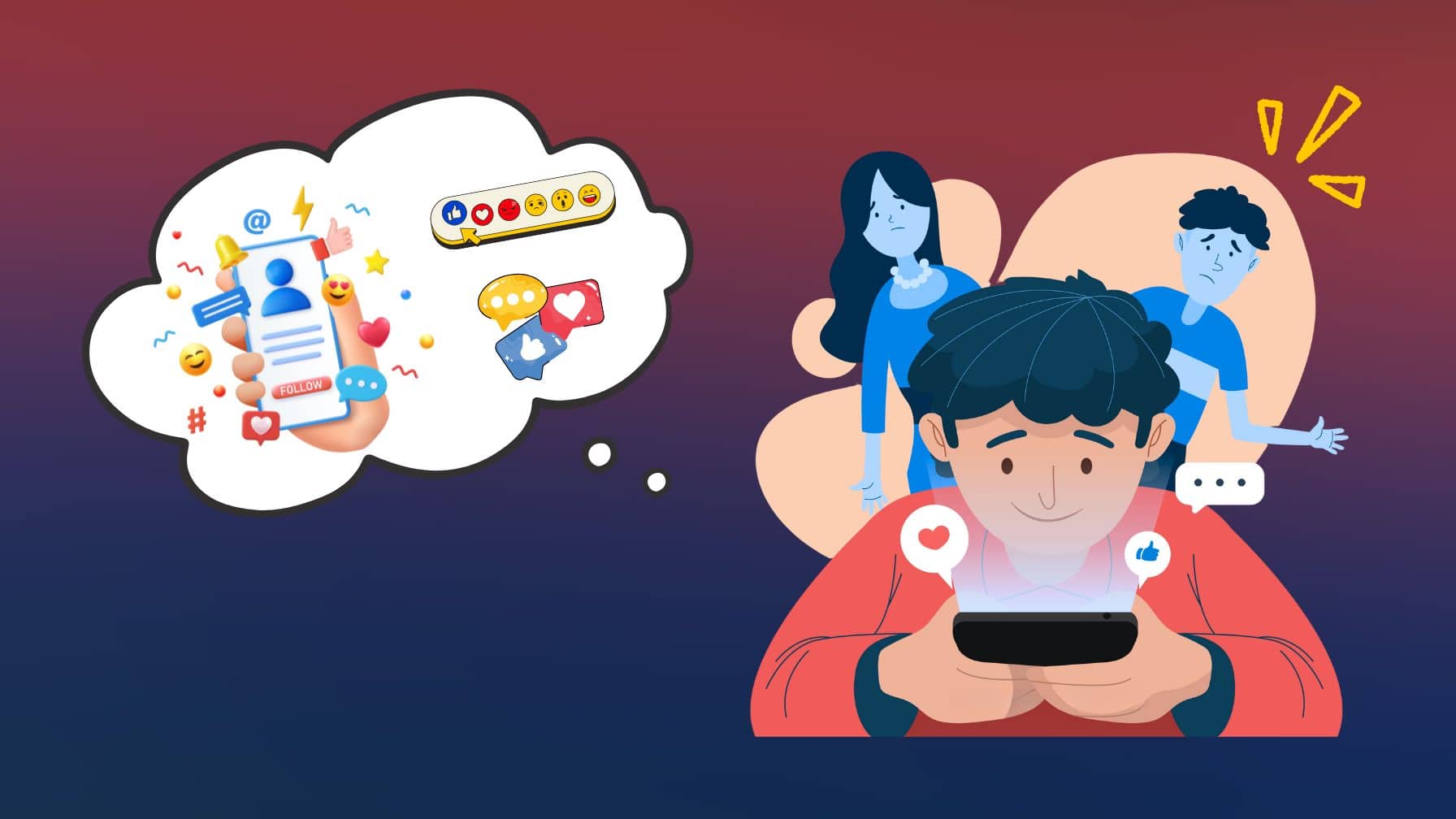


Something quietly shifted in how the UK uses social media, and the numbers finally caught up with it.
In Ofcom’s Adults’ Media Use and Attitudes report published in April 2026, just 49% of social media users said they still post, share or comment. Two years earlier that figure was 61%. Meanwhile a quarter of users now limit themselves to hitting like, and another quarter simply read without interacting at all.
We didn’t leave social media. We stopped speaking on it and started watching it.
That’s a meaningful change for our mental health, and it cuts both ways — there’s the strain of constantly observing other people’s lives, and the quieter strain of feeling observed in your own. This article looks at what the evidence actually supports on both, including the parts where the science is far less settled than the headlines suggest.
Britain Has Quietly Become a Nation of Watchers
The baseline first. Ofcom’s 2026 survey of 7,533 UK adults found 89% of adult internet users are on at least one social platform, rising to 97% among 16–34s. Its Online Nation report put average time online at 4 hours 30 minutes a day, ten minutes more than the year before.
What’s changed isn’t volume. It’s posture. Alongside the drop in posting, Ofcom recorded a fall in how people feel about the whole thing: those saying social media benefits their mental health dropped to 36%, down from 42%, and those who think the benefits of being online outweigh the risks fell to 59% from 72%.
One finding explains a lot of the retreat: 49% of users are worried their posts could cause them problems in the future, up from 43%. Ofcom’s qualitative work found people gravitating towards content that expires — Stories rather than permanent grid posts — while some had stopped posting altogether.
A fair caveat, and Ofcom flags it themselves: their methodology changed this year, so the year-on-year shifts are best read as a direction of travel rather than precise figures.
For context on the emotional backdrop, the ONS found in early 2026 that 33% of UK adults reported high anxiety, rising to 43% among 16–29s — the most anxious age group.
What the Research Actually Says About Passive Scrolling
Here’s where you’d expect a health article to tell you that passive scrolling is quietly wrecking your mind. The honest answer is more interesting.
The concern has real experimental roots. Verduyn and colleagues (2015, Journal of Experimental Psychology: General) ran a lab experiment plus a six-day study texting participants five times a day. Passive Facebook use predicted a decline in how people felt — and the mechanism was envy. Escobar-Viera et al. (2018) later found in 702 US adults that each increase in passive use was associated with 33% higher odds of depressive symptoms, while active use was linked to lower odds.
But the follow-up work complicated that story considerably, and any honest write-up has to say so.
Valkenburg and colleagues (2022, Journal of Computer-Mediated Communication) tracked 353 adolescents six times a day for three weeks — nearly 33,000 observations. When they looked at individuals rather than averages, they found that browsing made 20% feel worse, made 17% feel better, and had no detectable effect on the remaining 63%. The same team’s review in New Media & Society concluded the tidy “active good, passive bad” rule isn’t supported by the wider literature. The debate is live enough that Journal of Media Psychology published an adversarial review in 2023, with two researchers arguing opposite sides.
So the accurate version isn’t “scrolling harms you.” It’s this: passive use harms some people, some of the time, and what seems to decide it is what the scrolling stirs up. In the Valkenburg data, teens whose browsing triggered envy were the ones who suffered; those who found it enjoyable often felt better.
Which makes the useful question not how long you spent looking, but how you felt afterwards.
The Comparison Trap: Why “Looking Up” Leaves a Mark
The envy finding points at the oldest idea in this field. Festinger’s social comparison theory (1954) proposed that we work out our own worth by measuring ourselves against other people. Social media just industrialised the process.
The most current evidence is a 2026 meta-analysis in Frontiers in Psychology pooling 94 effects across 54 samples — 36,583 people. Online upward comparison, meaning looking at people who appear to be doing better, showed moderate associations with:
- socially-evaluative negative emotions (r = 0.46)
- anxiety (r = 0.38)
- lower wellbeing (r = 0.31)
- depression (r = 0.27)
- lower self-esteem (r = 0.25)
Those are real associations. The authors are also careful, and so should we be: most of the included studies were cross-sectional, which means causality can’t be established. It’s entirely plausible that people already feeling low compare upward more often, rather than the comparison causing the low mood. Probably both, feeding each other.
In the UK specifically, the Mental Health Foundation has reported that 22% of adults said images on social media had caused them to worry about their body image, and 32% had felt negatively about themselves through comparison — 41% of women and 22% of men.
The Other Half: the Anxiety of Being Watched Yourself
This is the side that gets far less coverage, and it may explain Britain’s retreat from posting better than anything else.
Duffy and Chan (2019, New Media & Society) interviewed young adults about who they imagine is looking at their posts. Participants described anticipating scrutiny from family, universities and future employers — and adjusting themselves accordingly: privacy settings, self-censorship, secondary accounts. The researchers called it imagined surveillance. You don’t need to be watched. You only need to believe you might be.
Marwick and boyd (2011) had already named the structural cause: context collapse. Offline, you present differently to your boss, your nan and your mates. Online, they’re all in one audience, so you end up writing for an imagined composite of everyone at once — and satisfying nobody, least of all yourself.
Marder and colleagues (2016) went further, describing an extended “chilling effect”: awareness of a potential online audience alters behaviour even offline, because anyone might photograph a moment and post it.
Put that beside Ofcom’s finding that half of users now fear their own posts could rebound on them, and the picture is coherent. People aren’t withdrawing because they’re bored. They’re withdrawing because posting started to feel like exposure.
And it applies to small acts too. Instagram shows the owner of a Story who watched it. That single design decision converts an idle glance into a logged, visible event with your name attached — which is precisely the kind of low-grade, always-on self-consciousness this research describes.
The Breakup Exception, Where Watching Does Measurable Harm
If there’s one behaviour with a consistently unhelpful evidence base, it’s monitoring an ex-partner.
Marshall (2012, Cyberpsychology, Behavior, and Social Networking) surveyed 464 people and found that keeping tabs on a former partner online was associated with greater current distress about the breakup, stronger negative feelings, more longing for the ex, and less personal growth.
There’s a genuinely counterintuitive detail in that study. People who stayed friends with an ex online reported fewer negative feelings and less longing — but also less personal growth. Staying connected and actively checking up aren’t the same behaviour, and they carry different costs.
The usual caution applies: this was cross-sectional, so we can’t say checking causes a slower recovery. People struggling more may simply check more. Either way, if you recognise yourself in it, the loop is worth interrupting.
Keep the Effect Sizes in Perspective
A health article that only stacked up alarming findings would be misleading you, so here’s the counterweight.
Orben and Przybylski (2019, Nature Human Behaviour) analysed three large datasets totalling 355,358 people and found the association between adolescent wellbeing and digital technology use was negative but tiny — explaining no more than 0.4% of the variation. Their memorable comparison: an effect size in the same territory as regularly eating potatoes. Coyne and colleagues (2020) followed people for eight years and found that increases in an individual’s own social media time did not predict worsening mental health.
The most-quoted claim in this whole area also deserves a caveat. The RSPH’s 2017 #StatusOfMind report, which ranked Instagram worst of five platforms for young people’s mental health, surveyed 1,479 young people aged 14–24 across the UK. It’s been widely criticised since — most publicly by Cambridge psychologist Amy Orben — on the grounds that you can’t establish a platform’s mental health impact by summing responses to 14 self-designed questions, and that it went to the press without peer review.
Faelens et al. (2021), reviewing the Instagram-specific literature, landed somewhere sensible: there’s reasonable evidence linking Instagram use to social comparison and body image concerns, while findings on depression, anxiety and stress remain inconclusive.
The honest summary: for most people, most of the time, social media is not the main driver of their mental health. For a minority, and in specific patterns of use, it clearly makes things harder.
What Actually Helps, and What’s Oversold
The intervention research is where expectations most need managing.
The famous study is Hunt et al. (2018), the “No More FOMO” experiment: 143 university students capped at 10 minutes per platform per day for three weeks reported significant reductions in loneliness and depression. It’s cited constantly.
What almost never gets mentioned is that anxiety and FOMO fell in both groups — including the control group that didn’t limit anything. The authors attributed this to self-monitoring: simply paying attention to your own use changed something.
And the broader picture is sobering. Burnell and colleagues (2025) meta-analysed 32 randomised controlled trials covering 5,544 participants. Restricting social media did significantly improve wellbeing — but the pooled effect was g = 0.17, which is small. Their own conclusion describes it as “only weak support” for restriction as a strategy. A separate 2025 meta-analysis of 10 RCTs found a similarly modest effect on depressive symptoms (g = 0.25).
So deleting the apps is not the cure it’s marketed as. What the evidence points towards instead is subtler and more practical:
- Track how you feel, not how long you scrolled. Self-monitoring carried real weight in the Hunt study. Note your mood after a session for a week. If a particular account reliably leaves you deflated, that’s data.
- Prune upward comparisons specifically. The meta-analytic evidence targets upward comparison, not screen time in general. Mute the accounts that trigger it. You don’t need to quit the platform.
- Watch the night-time drift. Ofcom found a meaningful share of young people’s platform time falls between 9pm and 5am — the hours when sleep loss and rumination compound each other.
- Separate looking from performing. Much of the strain Ofcom captured isn’t from consuming content; it’s from the pressure of being visible. Reading without posting is a legitimate way to use these platforms.
- Reduce the friction that makes looking feel risky. If part of your anxiety is that checking a public profile gets logged and shown to its owner, that’s a design problem, not a character flaw. Some people handle it with a browser-based instagram story viewer, which loads public Stories and posts without you logging in, so nothing appears in the owner’s viewer list. It works only on public accounts — anything advertising access to private profiles is a scam, and typically after your login or your card. Worth being clear-eyed, though: removing the trace removes the self-consciousness, not the underlying pull. If you’re checking an ex’s profile six times a day, the tool isn’t the thing that needs changing.
- Post something occasionally, if you used to. Active use was the protective half of the original Verduyn model, and while that model is contested, nothing in the newer research suggests silence is better than connection.
When it’s more than a habit
Some of this goes beyond self-management, and a wellbeing article shouldn’t pretend otherwise.
If low mood, anxiety or compulsive checking is affecting your sleep, work, relationships or appetite for more than a couple of weeks, that’s worth raising with your GP. NHS talking therapies in England accept self-referral without a GP appointment. If you’re in distress right now, the Samaritans are available free on 116 123, at any hour.
The wider context matters here: the ONS figure of 43% high anxiety among 16–29s isn’t a social media statistic. It reflects a great deal more than what’s on anyone’s phone, and it deserves proper support rather than a screen-time app.
The Takeaway
Britain is watching more and saying less, and the research suggests both halves of that carry a cost — the comparison that comes from watching, and the exposure that comes from being watched.
But the effects are smaller and far more individual than the headlines imply. The people harmed by scrolling appear to be the ones it makes envious. The intervention that helped most in the best-known study also helped the group that changed nothing. The most reliable move isn’t a detox or a dramatic deletion. It’s paying attention to which parts of this actually leave you feeling worse — and being willing to adjust just those.
This article is for general information and isn’t medical advice. If you’re worried about your mental health, please speak to a GP or a qualified professional.