
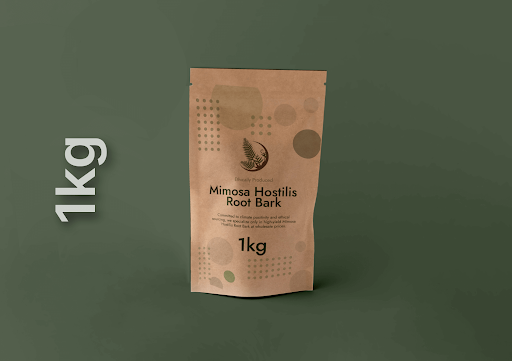


Mimosa hostilis root bark powder is a processed plant material associated with Mimosa tenuiflora, a woody legume native to regions of tropical America. The species has a particularly strong connection with northeastern Brazil, where it occurs in vegetation adapted to pronounced seasonal dryness.
The terminology surrounding this plant can be confusing. Older sources frequently use Mimosa hostilis, whereas contemporary botanical references commonly identify the species as Mimosa tenuiflora. The abbreviation MHRB is generally used to describe root bark associated with the historical name.
Looking at the material through botany, plant anatomy, ecology, and post-harvest processing provides a more useful understanding than focusing only on its powdered appearance.
A Botanical Profile of the Source Species
Mimosa tenuiflora is classified within the Fabaceae family. This family includes a wide range of flowering plants, from herbaceous species to large woody trees.
The species belongs to the Mimosa genus, which contains numerous plants with different ecological characteristics. Its identity is therefore defined by the complete scientific name rather than the word “Mimosa” alone.
As a woody species, Mimosa tenuiflora develops persistent stems and roots. Depending on environmental conditions, individuals can take the form of shrubs or small trees.
Its compound leaves, thorn-bearing branches, flowers, and seed pods provide useful morphological characteristics when an intact specimen is available.
A Species Shaped by Seasonal Climate
The native environment of Mimosa tenuiflora is an important part of its biological story.
Northeastern Brazil includes extensive areas affected by seasonal rainfall and prolonged dry periods. Vegetation in these landscapes must tolerate substantial changes in water availability.
Mimosa tenuiflora is capable of occupying such environments and can also occur in disturbed landscapes. Its ecological distribution demonstrates an ability to persist where environmental conditions may be unfavorable for less drought-tolerant plants.
The soil, rainfall regime, temperature, and surrounding vegetation can all influence how an individual plant develops.
Root Systems and the Formation of Bark
A tree or shrub relies on its roots for anchorage and for acquiring water and mineral nutrients from the soil. Woody roots also develop protective outer tissues as they mature.
Root bark is therefore a structural component of the underground portion of the plant. Its characteristics are influenced by the age and development of the root as well as the surrounding soil environment.
Roots are exposed to physical pressure from soil particles and interact with microorganisms and changing levels of moisture. These conditions differ considerably from those experienced by leaves and above-ground stems.
This helps explain why root-derived material can have its own characteristic texture and density.
How Fresh Bark Becomes a Dried Material
Fresh plant tissues contain water, which contributes to their flexibility and mass. When root bark is dried, the reduction in moisture causes substantial physical changes.
The material becomes more rigid and generally more fragile. Its surface may become rougher or more pronounced as moisture is removed.
The outcome depends partly on the conditions used during drying. Temperature, airflow, humidity, and the starting condition of the plant material can influence the resulting physical characteristics.
Drying should therefore be understood as a transformation of the plant material’s physical state rather than simply a reduction in weight.
What Grinding Does to Root Bark
Grinding introduces another major physical change.
A relatively large section of bark may retain layers, fibers, edges, and other structural features. Mechanical grinding breaks those structures into increasingly smaller particles.
At a fine particle size, the original shape of the bark is no longer obvious. Instead, the material becomes a loose powder whose appearance is dominated by particle size and overall coloration.
The phrase Powdered mimosa hostilis 1kg describes a quantity and physical preparation of botanical material. It does not identify a separate cultivar, subspecies, or taxonomic group.
Powder Has a Different Surface-Area Profile
One important physical principle behind powdered plant material is surface-area expansion.
Breaking a large piece into many small particles dramatically increases the amount of material exposed to the surrounding environment. This can influence how the powder responds to humidity and other storage conditions.
Fine particles may absorb atmospheric moisture more readily than larger pieces. Under humid conditions, this can lead to changes in flowability, texture, and the formation of clumps.
Consequently, particle size is relevant when considering the general preservation of dried botanical materials.
Why the Powder May Not Look Identical Everywhere
Plant-derived materials are inherently variable. A single standardized appearance should not be expected.
Several factors can influence the final appearance of root bark powder:
- Age of the source plant
- Geographic location
- Soil composition
- Rainfall
- Temperature
- Root development
- Drying conditions
- Grinding process
- Storage history
These variables can influence the shade, texture, and consistency of the resulting powder.
For that reason, visual differences between samples should not automatically be interpreted as evidence of different botanical origins.
Color Provides Limited Identification Information
Brown and earthy shades can occur in dried woody plant material, but color alone has limited taxonomic value.
Botanical identification generally relies on multiple characteristics rather than one visual feature. With a living Mimosa tenuiflora specimen, researchers can examine leaves, flowers, fruits, branches, bark, and overall growth form.
A root-bark powder does not retain most of those characteristics.
This creates an important distinction between physical description and scientific identification. A powder can be described visually, but its appearance alone cannot reliably establish its species.
The Loss of Morphological Clues During Processing
Botanical morphology depends on visible structures.
Leaves reveal arrangement and leaflet characteristics. Flowers provide reproductive features. Fruits and seeds provide additional evidence. Branches and bark contribute information about growth form and development.
Grinding removes nearly all of these structures.
This means that extensive processing reduces the amount of morphological evidence available for examination. When a sample consists only of fine particles, information about its documented origin becomes much more significant for botanical research.
Environmental Factors Continue to Matter After Drying
Although drying changes the plant material, environmental exposure does not stop there.
Humidity can influence dry powders after processing. Temperature and light exposure can also contribute to physical changes over time.
A clean, dry, stable environment is generally preferable for maintaining dried botanical materials. Containers that reduce unnecessary exposure to moisture and airborne contamination can also help protect the material’s physical condition.
Visible mold, persistent unusual odors, unexpected dampness, or insect contamination are indications that a dried botanical material may have deteriorated.
Why the Species Has Two Familiar Names
The naming history of this plant is another important part of understanding it.
Mimosa hostilis is an older scientific designation. Mimosa tenuiflora is commonly encountered in current botanical literature.
Taxonomic names can change when scientific understanding of plant relationships develops. Older publications remain valuable, but their terminology may differ from modern references.
Consequently, researchers studying this species may need to recognize both names when searching historical literature or comparing sources from different periods.
Online Terminology Does Not Always Follow Modern Taxonomy
Web content frequently combines scientific terminology from different periods.
The phrase mimosahostilis.shop, for example, contains the historical species name rather than the modern Mimosa tenuiflora designation.
This illustrates a broader point about online botanical research: terminology used in a website address, product description, or search phrase does not necessarily represent the latest taxonomic convention.
Cross-checking names against reputable botanical references is a better approach when precise identification matters.
The Role of Geographic Information
Geographic information can add valuable context to plant identification.
A species has a natural distribution shaped by climate, soils, competition, and historical ecological processes. Mimosa tenuiflora is strongly associated with northeastern Brazil but is also found elsewhere in Latin America.
Local environmental differences can produce variation between populations. Plants from different settings may develop somewhat different dimensions, bark characteristics, or growth patterns while remaining members of the same species.
Geography should therefore be treated as supporting evidence rather than a standalone identification method.
Ethnobotanical Records Add Historical Context
Mimosa tenuiflora has also been documented in ethnobotanical literature.
Ethnobotany examines how human communities understand and interact with plants. Historical records can provide information about the cultural recognition of species and their place within local traditions.
These records are valuable for understanding the history of a plant, but they should be distinguished from modern laboratory or clinical evidence. Historical use does not by itself establish present-day safety, efficacy, or suitability.
Comparing the Material at Different Processing Stages
The progression from plant to powder can be viewed as a gradual loss of visible structure:
| Stage | Main feature | Morphological information |
| Living plant | Complete biological organism | Extensive |
| Root section | Woody underground structure | Moderate |
| Dried bark | Preserved physical tissue | Limited |
| Coarse fragments | Reduced structural form | Low |
| Fine powder | Highly divided particles | Very low |
This illustrates why botanical context becomes increasingly important as processing removes recognizable plant features.
Frequently Asked Questions
What plant is associated with Mimosa hostilis root bark?
The material is associated with Mimosa tenuiflora, historically known as Mimosa hostilis.
What does the term root bark mean?
It refers to the outer tissues associated with the roots of a woody plant.
Why is root bark made into powder?
Grinding changes the physical form of dried plant material and produces much smaller particles.
Does grinding create a different botanical variety?
No. Processing changes physical form, not botanical classification.
Why can powder samples differ in appearance?
Natural plant variation and differences in drying, processing, geography, and storage can affect appearance.
Can color identify the species?
No. Color alone is insufficient for reliable botanical identification.
Is Mimosa tenuiflora adapted to dry environments?
Yes. It is strongly associated with seasonally dry regions of Latin America.
What family contains Mimosa tenuiflora?
The species belongs to Fabaceae.
Why is Mimosa hostilis still used as a name?
It is a historical botanical name that remains common in older literature and general online terminology.
Conclusion
Mimosa hostilis root bark powder represents the finely processed root-bark material associated with Mimosa tenuiflora, a woody member of the Fabaceae family. Its botanical background is closely tied to the dry and seasonally variable environments of Latin America, particularly northeastern Brazil.
The appearance of the finished powder reflects many stages of biological development and physical processing. Plant age, habitat, root structure, drying, grinding, humidity, and storage can all influence its characteristics.
Most importantly, powdered material should not be confused with a botanical specimen that can be identified through complete morphology. Once leaves, flowers, fruits, and other structures are absent, visual identification becomes considerably more limited.
Understanding the species’ taxonomy, ecology, root anatomy, and processing history therefore provides a more scientifically grounded way to interpret information about Mimosa hostilis root bark powder.