


Laboratories today face increasing revenue pressure due to complex payer requirements, evolving coding standards, and tighter reimbursement policies. Even small billing errors can lead to delayed or denied payments, directly impacting cash flow.
At the same time, labs are dealing with rising denial rates, staffing shortages, and growing compliance demands. Managing billing operations efficiently has become more challenging as workloads increase and regulations continue to change.
The choice between in-house and outsourced billing directly impacts revenue, efficiency, and scalability. Read till the end to see how outsourcing lab billing services can help you.
What Is In-House Lab Billing?
In-house lab billing refers to managing all billing processes internally within the laboratory. This includes charge entry, coding, claims submission, payment posting, and denial management handled by an internal team.
This model gives laboratories full control over workflows, allowing customization based on internal preferences and operational needs. However, it also creates dependence on internal staff, training programs, and infrastructure, which can limit flexibility and efficiency over time.
What Is Outsourced Lab Billing?
Outsourced lab billing involves partnering with a third-party billing company to manage the laboratory revenue cycle. These vendors typically provide end-to-end revenue cycle management (RCM) services, from coding and claims submission to payment posting and denial resolution.
Outsourcing offers access to expert coders, advanced billing technology, and industry best practices. Many providers operate on performance-based pricing models, aligning their incentives with revenue outcomes.
In-House vs Outsourced Lab Billing: Key Differences
| Factor | In-House Billing | Outsourced Billing |
| Cost Structure | Fixed salaries + overhead | Percentage-based or flat fee |
| Control | Full internal control | Shared control |
| Expertise | Limited to team skills | Access to specialists |
| Scalability | Limited | High |
| Technology | Requires investment | Included |
Cost Breakdown: In-House vs Outsourced Lab Billing
The cost difference between in-house and outsourced lab billing depends on staffing, technology, and claim volume.
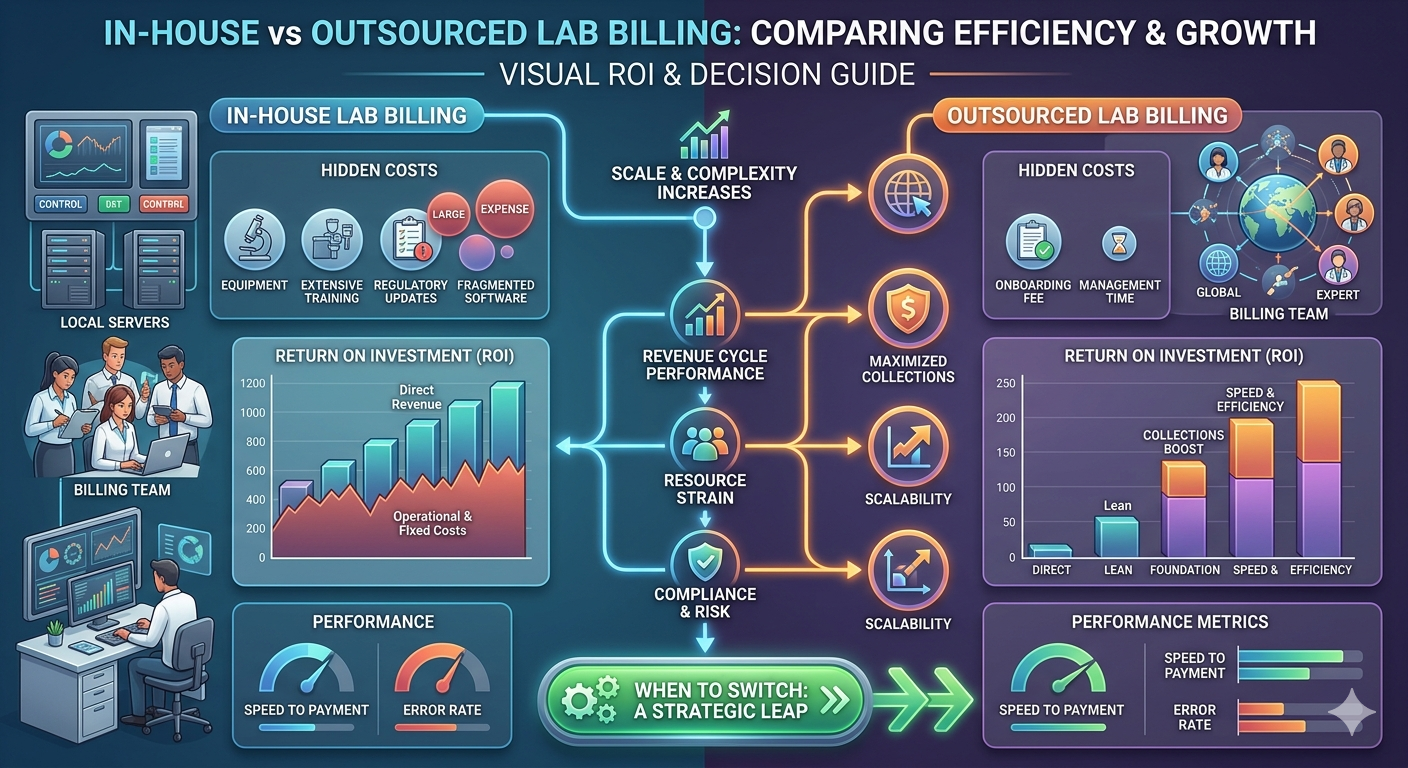
In-House Costs
In-house billing requires significant upfront and ongoing investment. Key expenses include:
- Salaries for billers and coders
- Training and compliance programs
- Billing software and clearinghouse fees
- Revenue loss from denied or underpaid claims
Outsourced Costs
Outsourcing typically involves variable pricing based on performance. Common costs include:
- A percentage of collections (usually 4–10%)
- Initial setup or transition fees
- Contractual service terms and add-ons
ROI Comparison: Which Model Generates More Revenue?
ROI in lab billing is measured by collections, denial rates, and days in accounts receivable (AR). Outsourced billing often delivers higher clean claim rates due to specialized expertise and automated processes.
Additionally, third-party providers can accelerate reimbursements and reduce administrative burden on internal teams. In contrast, in-house billing may suffer from hidden inefficiencies such as outdated workflows or limited expertise, which can negatively impact overall revenue performance.
When Should a Lab Outsource Billing?
Labs should consider outsourcing billing when internal processes begin to impact revenue performance. Common indicators include:
- Rising denial rates
- Increasing AR days
- Limited internal expertise
- Rapid growth or scaling
- Compliance challenges
How to Choose the Right Lab Billing Model
Choosing between in-house and outsourced lab billing depends on the laboratory’s size, resources, and growth goals. Smaller labs with limited staff may benefit from outsourcing, while larger organizations may prefer maintaining internal control.
Key decision factors include budget constraints, complexity of testing (such as molecular or genetic diagnostics), growth plans, and compliance requirements. Evaluating these elements helps determine which model aligns best with long-term operational and financial objectives.
How Transcure Supports Labs with Outsourced Lab Billing
Labs looking for a reliable partner can explore Transcure’s lab billing services to improve efficiency and optimize revenue cycle performance. Transcure helps laboratories streamline their billing operations by providing end-to-end revenue cycle management tailored to lab-specific workflows. From accurate charge entry and coding to timely claims submission and denial management, Transcure ensures higher clean claim rates and faster reimbursements.
As an outsourced partner, Transcure combines expert billing teams with advanced automation tools to reduce administrative burden and improve financial performance. The company also offers real-time reporting, compliance support, and scalable solutions, making it easier for labs to handle increasing claim volumes without expanding internal staff.
Conclusion
Both in-house and outsourced lab billing models offer distinct advantages and trade-offs. While in-house billing provides control and customization, outsourcing delivers scalability, expertise, and often stronger financial outcomes.
Ultimately, the right choice should be driven by ROI and operational efficiency. Laboratories should evaluate key billing performance metrics such as denial rates, AR days, and collection rates before making their decision.