


Robots are no longer a concept limited to an imaginary world, but they are real and actively shaping how industries operate today.
From manufacturing to healthcare, they have become a powerful tool to improve efficiency, accuracy, and safety across different sectors.
As these machines continue to evolve their ability to process data in real time and communicate with systems,they rely on cloud computing, AI integration, and a fast and reliable internet connection.This is where dependable connectivity solutions come into play.
Users exploring robotics technologies can benefit from subscribing to a high-speed service like altafiberInternet.And for those looking to understand available options, reaching out to altafibercustomer service is a convenient way to explore internet plans that support modern, tech-driven needs.
Moving on, in this article, I will discuss what robots are, how they are helping in different industries, and what their future holds. To learn about all these things, don’t lose your focus and read this article carefully.
What is Robotics?
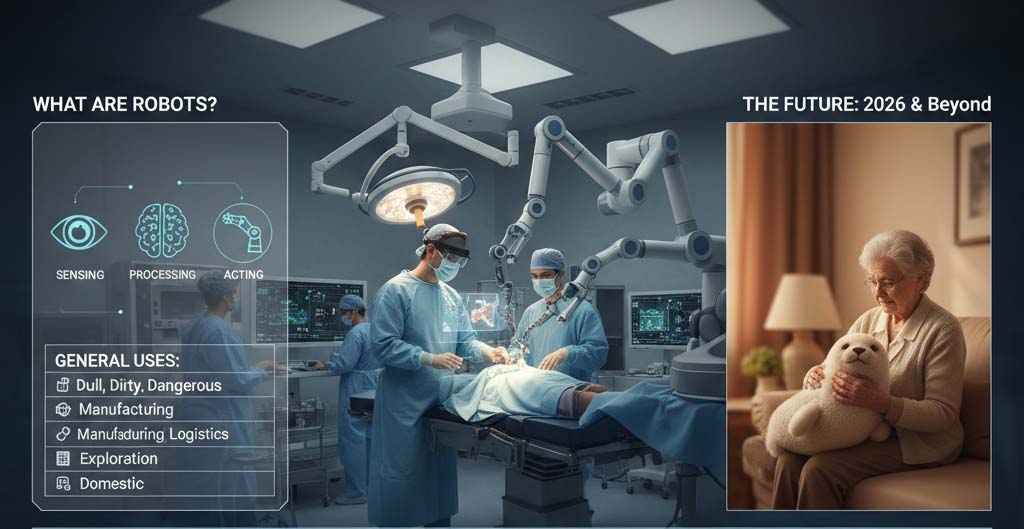
Robotics is a field of operating, constructing, designing, and using robots that are integrated with computer science, math, and engineering to create machines that can automate tasks, replacing humans’ dangerous and dull jobs.
This increasingly performs complex actions autonomously or through human intervention. Robotics involves creating machines that have sensors, control systems, and motors that can perceive the environment, make decisions, perform physical actions, and process information to improve efficiency and safety in many industries, like space exploration, health care, and manufacturing.
Different Types of Robots
As mentioned above,robots are being used in different industries to automate tasks and improve the overall efficiency, such as:
Healthcare
Robots are transforming the healthcareindustry by improving surgical precision, assisting with patient care, streamlining logistics, automating tasks, and freeing up human staff for complex procedures.
They aim to perform duties like disinfecting rooms, delivering medical supplies, performing surgery, for example, the Da Vinci system, and supporting rehabilitation.
Smart Homes
The smart home concept is very popular in homes in the US.Smart homes are integrated with robotic systems that aim to improve the living conditions of people by automating tasks. This, in turn, improves the overall efficiency and workflow.
A smart home consists of many features, for example, a smart entertainment system that handles the entertainment system of your home,including audio, TV, and temperature, to give you a cozy environment for your movie night.
Moreover,asmart home also consists of a smart kitchen, gardening, temperature, andmany other things. They all have one aim: to minimize human intervention to keep life easy and simple for them, so that work can be done easily without any disturbance.
Military
Robots are used in the military to reduce the risk to human life, mostly in labor-intensive and high-risk tasks like surveillance and explosive disposal. These robotics systems range from semi-autonomous to remote control drones that are operated by humans, so that the control can be retained over lethal force decisions.
Aerial vehicles like drones and UAVs are used for long surveillance, target tracking, and gatheringreal-timebattlefield intelligence. Unmanned ground vehicles also perform scouting and monitoring in dangerous ground environments.
Lastly, robots are important in locating trapped or missing personnel, especially in environments that are dangerous or inaccessible for humans, such as areas with radioactive, biological, and chemical threats and collapsed buildings.
Advantages of Having a Robotics System
Enhanced Productivity and Efficiency
Unlike humans, robots do not require holidays, sleep,orbreaks; they can work 24/7, which increases production time and efficiency of the work.
This also leads to faster cycle times as robots can perform tasks at a constant high speed without any fatigue, which leads to faster production cycles and ultimately more output.
Moreover, robots are best for doing repetitive tasks; unlike humans, they do not get boredwith doing the same task every day. Automating jobs frees the human workforce to focus on more complex and creative tasks.
Improved Safety and Risk Reduction
A major advantage of robotsis that they can be easily deployed in environments that are dangerous, for example, a place with toxic substances, extreme temperatures, high radiation, and inaccessible spaces.
Moreover, by removing humans from risky operations like lifting heavy loads or working with dangerous machinery, robots can help prevent workplace injuries and accidents.
Innovation and Advancements
Robots help in data analysis and collection, as many of them are equipped with sensors and cameras that collect a large amount of data in real-time. This is set to monitor and refine the processes that drivecontinuous improvement and rapid innovation.
Robotics technology also contributestopushing the boundaries of associated technologies like ArtificialIntelligenceand machine learning,which leads to a better economic and societal process.
Technological Advances in Robotics
The future of robots is defined by advancements in artificial intelligence, improved hardware, and enhanced sensor technology. I feel like in the future, instead of being a niche technology, they will become a more active part of our everyday life, which may unlock a new era of human and robot collaboration.
They are being transitionedfrom a pre-programmed tool to an intelligent and autonomous system that can learn and adapt to dynamic environmentsand make complex decisions in real-time. Generative AI will enable more natural human-robot interactions using natural language.
Lastly, the Internet of Things and 5G internet will allow robots to communicate seamlessly,which may create an interconnected smart environment, like smart cities and automated factories.
Final Thoughts
As robotics continues to advance, its impact across industries will only grow stronger. Understanding how robots work, where they are used, and what the future holds helps us better prepare for a world where humans and intelligent machines collaborate more closely.
Staying informed regarding these advancements is important for innovation and making the most of the opportunities robotics has to offer.