
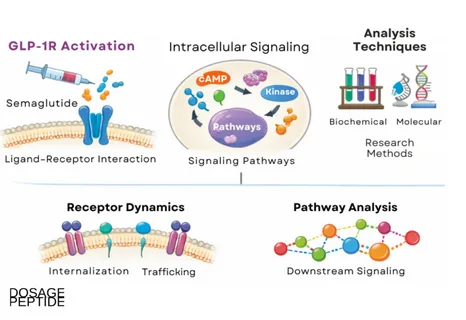


Peptide research spans several areas of modern biology, including metabolic signalling, cellular processes, tissue biology and the investigation of molecules involved in physiological regulation. As interest in these fields grows, researchers need to distinguish established scientific evidence from early-stage findings, understand the limitations of experimental compounds and evaluate the quality of laboratory materials before drawing conclusions.
A structured approach begins with the biological question, the available evidence and the analytical methods used to assess a material. Product names and stated quantities alone cannot establish efficacy, safety or suitability for a particular experiment. These distinctions are especially important when researching compounds associated with weight regulation, cellular longevity and tissue-related pathways.
Understanding Peptides and Their Role in Biological Research
Peptides are short chains of amino acids linked by peptide bonds. Depending on their structure, they may interact with receptors, participate in signalling pathways or influence other molecular processes. Their biological activity depends on factors such as amino acid sequence, molecular structure, receptor interactions and the experimental environment.
In laboratory research, scientists may investigate how a particular peptide behaves in a defined model, whether it interacts with a target pathway and how experimental findings compare with existing literature. These questions require controlled methods, appropriate comparison groups and reproducible measurements.
An important distinction exists between a promising research hypothesis and an established clinical application. Findings from laboratory experiments do not automatically translate into demonstrated benefits in humans. Further evidence may be required to establish pharmacological properties, safety, appropriate dosing and clinical effectiveness.
Metabolic Research: Retatrutide, Tirzepatide and Cagrilintide
Metabolic signalling is an important area of contemporary biomedical research. Scientists investigate hormones, receptors and related pathways to better understand appetite regulation, energy balance, glucose metabolism and other aspects of metabolic physiology.
Retatrutide is an investigational molecule studied for its activity at multiple hormone receptors, including the glucagon-like peptide-1 (GLP-1), glucose-dependent insulinotropic polypeptide (GIP) and glucagon receptors. Tirzepatide acts at GIP and GLP-1 receptors, while cagrilintide is an amylin analogue investigated in metabolic research.
Although these compounds are discussed within the same broad field, they are not interchangeable. Their receptor activity, pharmacological characteristics, evidence base and regulatory status must be considered separately. Comparing them responsibly means examining the relevant published research rather than assuming that similar research interests imply equivalent effects.
For catalogue identification and documentation, Clova Care lists retatrutide research material, alongside KLIKJARO tirzepatide 40mg and KLIKJARO tirzepatide 60mg. Its catalogue also includes KLIKTIDE cagrilintide 10mg.
Combination listings require additional scrutiny. A combination name does not, by itself, establish the quantity of each constituent, the compatibility of the ingredients or a combined biological effect. Clova Care separately lists RETAKLIK 2.0, containing retatrutide and cagrilintide, and retatrutide and cagrilintide 45mg. These are distinct catalogue records, so their stated composition and supporting documentation should be assessed individually.
Cellular Biology, Longevity and Energy-Related Research
Cellular research examines how cells maintain their functions, respond to stress and regulate processes such as protein turnover, signalling and energy metabolism. Research into ageing and cellular longevity is particularly complex because these processes involve multiple interacting biological systems rather than a single pathway.
NAD+ is a coenzyme involved in oxidation-reduction reactions and cellular metabolism. It also participates in processes associated with cellular signalling. Researchers investigate NAD+ biology to understand how cellular metabolism changes under different experimental conditions. However, a mechanistic role in cells does not establish that a particular research material will improve longevity or produce a clinical benefit.
MOTS-C is a mitochondria-associated peptide studied for potential roles in metabolic regulation and cellular signalling. Its biological significance remains a subject of research, and experimental findings must be interpreted in light of the model, study design and available evidence.
For catalogue reference, the relevant Clova Care listings include KLIKNAD+ NAD+ 1000mg and KLIKMOTS-C 10mg. When evaluating either listing, researchers should confirm the identity of the material, the stated quantity and the documentation associated with the specific product.
The broader lesson is that research into cellular pathways requires careful interpretation. A molecule’s involvement in a biological process is a starting point for investigation, not proof that a commercial preparation can alter that process beneficially in humans.
Tissue Biology and Recovery-Related Research
Tissue biology examines how cells and tissues respond to injury, mechanical stress, inflammation and changes in their surrounding environment. Researchers investigate numerous molecular signals in these areas, but the strength of evidence varies considerably between compounds and experimental models.
BPC-157 and TB-500 are names frequently encountered in discussions of experimental peptide research and tissue-related biology. However, interest in a compound should not be confused with robust evidence of clinical effectiveness. Claims about injury recovery, muscle repair or accelerated healing require suitable studies and cannot be established by a product label.
Clova Care lists KLIK157 BPC-157 10mg and KLIK500 TB-500 10mg as individual research materials. It also lists WOLVERINE, a BPC-157 and TB-500 combination, and the STRENGTH Bundle, which contains separately listed KLIK157 and KLIK500 products.
A combined listing and a bundle of separate products should not be treated as equivalent. The exact contents, constituent quantities and supporting documentation need to be checked independently. Researchers should also avoid interpreting a combination’s name as evidence of synergistic activity.
GHK-Cu and Research into Cellular Signalling
GHK-Cu is a copper-binding peptide investigated in connection with cellular signalling and tissue biology. Scientific interest in this molecule covers several experimental areas, but the relevance of individual findings depends on the specific research question and the quality of the available evidence.
A meaningful assessment should distinguish mechanistic studies from clinical investigations and should not assume that findings in one experimental setting apply to another. The formulation, material identity and study conditions can all affect how results should be interpreted.
Clova Care’s catalogue includes KLIK-GHK GHK-Cu as an individual listing. Its GLOW research combination lists BPC-157, TB-500 and GHK-Cu together.
These records should be reviewed separately. Documentation for an individual ingredient does not automatically verify a combined formulation, and the presence of several compounds in a listing does not demonstrate a particular outcome.
Why Laboratory Documentation Matters
Reliable research depends on knowing what material was tested and whether its identity and characteristics are adequately documented. A product description can identify a catalogue item, but it is not a substitute for analytical evidence.
A Certificate of Analysis (CoA) can help researchers assess the reported results for a submitted sample. Before relying on a report, check the following:
- Identity: Does the report identify the same compound as the catalogue listing?
- Sample reference: Can the tested sample be linked to the relevant product or batch?
- Reported methods: Are the analytical methods and results clearly stated?
- Purity and limitations: What does the reported measurement establish, and what remains unverified?
- Formulation: Does the report cover the individual material or the exact combination being investigated?
- Documentation currency: Is there evidence connecting the report to the material under consideration?
A reported purity percentage does not establish clinical safety, sterility, effectiveness or suitability for human consumption. Likewise, a laboratory report for one strength or sample should not automatically be applied to a different product or batch.
Researchers can consult Clova Care’s product and batch documentation to locate available reports and identify documentation questions that may need clarification.
How to Compare Research Materials Responsibly
A useful comparison framework begins with the research objective rather than the most prominent product name. First, identify the biological question and determine which compounds have relevant published evidence. Next, examine the experimental model, research methods and limitations of the available studies.
The material itself should then be assessed independently. Verify its stated identity, formulation, quantity and supporting analytical documentation. For combination products, confirm the identity and amount of each constituent rather than inferring the composition from a total quantity.
Finally, distinguish evidence about a molecule from evidence about a particular preparation. Even when a compound has been investigated in published research, that does not mean every commercial material bearing its name has been independently verified or shown to reproduce the reported findings.
This process helps prevent common errors, including confusing research-stage findings with clinical evidence, treating different compounds as interchangeable and assuming that a higher stated quantity necessarily indicates greater suitability.
Safety, Regulatory Status and Responsible Interpretation
Research materials must be handled within appropriate laboratory, ethical and regulatory frameworks. Products labelled for laboratory research are not medicines for self-treatment and should not be used for human or animal consumption.
Regulatory status can differ between compounds and jurisdictions. Investigational status, published studies and commercial availability do not establish approval for a medical indication. Anyone considering treatment for a health condition should consult a qualified healthcare professional and use appropriately authorised medicines through legitimate healthcare channels.
The same caution applies to claims involving weight management, longevity, tissue repair and recovery. These topics attract considerable interest, but responsible scientific communication requires clear distinctions between preliminary findings, established evidence and unproven claims.
Frequently Asked Questions
Are all research peptides supported by clinical evidence?
No. The amount and quality of evidence vary by compound. Laboratory findings, animal studies and human clinical trials answer different questions and should not be treated as equivalent.
Does a Certificate of Analysis prove that a product is safe for human use?
No. A CoA reports specified analytical findings for a submitted sample. It does not, by itself, establish clinical safety, efficacy, sterility or authorisation for human use.
Can two products containing related compounds be treated as equivalent?
Not automatically. Differences in formulation, constituent quantities, material identity and documentation may be important. Each listing should be assessed on its own evidence.
What should researchers check before interpreting a product listing?
Confirm the exact material identity, stated quantity, formulation, available analytical documentation and any limitations associated with the report. Compare those details with the requirements of the research protocol.
Conclusion
Peptide research offers a broad field of scientific questions involving metabolic signalling, cellular biology, tissue-related pathways and molecular interactions. Progress in these areas depends on careful experimental design, accurate material identification and a realistic assessment of the evidence.
Whether examining retatrutide, tirzepatide, cagrilintide, NAD+, MOTS-C, BPC-157, TB-500 or GHK-Cu, the essential principles remain the same: verify the material, review the relevant literature, examine the limitations of analytical reports and avoid turning a research hypothesis into an unsupported clinical claim.
Transparent documentation and evidence-led interpretation help researchers make more informed decisions while protecting scientific integrity and public trust.