
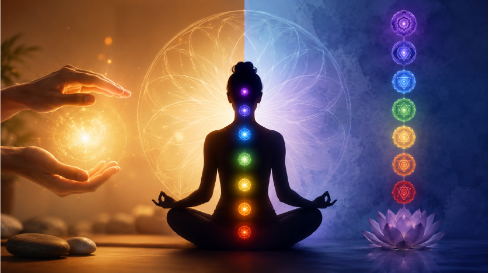


Reiki healing and chakra healing are often mentioned in the same breath, yet they are distinct practices with different origins, techniques and applications. Both fall under the umbrella of energy healing and complementary therapy, and both are increasingly used alongside conventional care in wellness settings, including some treatment centre and recovery programme environments.
Understanding the difference between chakra healing and reiki matters for anyone deciding which approach suits their needs, particularly those exploring holistic therapy for stress reduction, emotional healing or spiritual growth. This guide, drawn from over a decade of hands-on work with clients seeking complementary support, sets out the practical distinctions between the two disciplines and how each is typically experienced.
Reiki vs Chakra Healing at a Glance
Reiki is a specific, named modality developed in Japan, built around a practitioner channelling universal life force energy to the client through light touch or hands hovering above the body. Chakra healing is broader in scope.
It refers to any technique aimed at balancing the seven main energy centres of the body, and it can draw on sound, crystals, meditation, breathwork or hands-on methods, of which reiki is only one option. In short, reiki is a method; chakra healing is a goal that several methods can serve.
What Is Reiki Healing?
What Is Reiki and Where Did It Originate?
Reiki was developed in Japan in 1922 by Mikao Usui, and the word combines “rei” (universal) and “ki” (life energy). It spread to the West through Hawayo Takata in the mid-20th century and is now one of the most recognised forms of energy healing globally.
How Does Reiki Healing Work?
A reiki practitioner works on the premise that universal life force energy flows through the body, and that energy blockages contribute to physical tension, low mood or fatigue. The practitioner places hands lightly on or just above the client’s body in a defined sequence, aiming to clear these blockages and support the body’s own relaxation response. There is no manipulation of tissue and no diagnostic claim involved; it is considered a gentle, non-invasive complementary therapy rather than a medical treatment.
What Happens During a Reiki Session?
A typical session lasts 45 to 60 minutes. The client remains fully clothed, lying or seated comfortably, while the practitioner moves through a series of hand positions covering the head, torso and limbs. Many clients report warmth, tingling or deep relaxation, though experiences vary. First-time clients often expect something dramatic and are instead met with subtlety; managing that expectation beforehand improves satisfaction significantly.
What Is Chakra Healing?
What Are Chakras?
Chakras are described in traditional Indian and yogic systems as energy centres positioned along the spine, from the base to the crown of the head. Each is associated with specific physical, emotional and psychological functions, and imbalance in any one is thought to manifest as recognisable patterns of distress.
The Seven Main Chakras and Their Traditional Associations
The root chakra governs security and stability. The sacral chakra relates to creativity and emotional flow. The solar plexus chakra is linked to confidence and personal power. The heart chakra governs love, compassion and connection. The throat chakra relates to communication. The third eye chakra is associated with intuition, and the crown chakra with spiritual connection.
How Does Chakra Balancing Work?
Chakra balancing uses a range of techniques, including guided meditation, sound therapy, crystal placement, yoga postures and breathwork, to address perceived blockages in one or more of these centres. A practitioner assesses which chakras appear underactive or overactive, often through conversation and observation rather than a fixed protocol, then selects techniques accordingly. This is one area where past life regression is sometimes incorporated, particularly when a blockage is thought to relate to unresolved emotional patterns rather than a purely physical cause.
Reiki vs Chakra Healing: Key Differences
Difference in Focus and Approach
Reiki focuses on the whole-body flow of universal energy without targeting specific centres. Chakra healing is deliberately localised, addressing named points along the body according to the chakra system.
Difference in Techniques
Reiki relies almost exclusively on hand positioning and energy transmission. Chakra balancing draws on a wider toolkit, including sound, colour, crystals and visualisation, which can be combined or used independently.
Difference in Client Participation
Reiki is largely passive for the client, who simply receives the treatment. Chakra healing often invites more active participation, such as breathing exercises or guided visualisation during the session itself.
Difference in Session Experience
A reiki session tends to feel uniform from start to finish. A chakra healing session can feel more varied, moving through different techniques as the practitioner works down or up the chakra system.
Difference in Practitioner Training
Reiki training follows a structured, tiered system of attunements, typically Level 1, Level 2 and Master/Teacher level, each with defined criteria. Chakra healing has no single standardised certification body, so training quality and depth vary considerably between practitioners.
This inconsistency is worth checking carefully before booking, and it is one reason experienced clients often research a practitioner’s specific background, in the same way they might look into Jerry Sargeant reviews or similar practitioner track records before committing to a course of sessions.
How Are Reiki and Chakra Healing Similar?
Both practices sit within the wider field of energy healing and share the underlying premise that unseen energy affects physical and emotional wellbeing. Both are used as complementary therapy alongside, rather than instead of, conventional medical or psychological care. Both are commonly offered for stress reduction, emotional healing and general relaxation.
Can Reiki and Chakra Healing Be Combined?
Yes. Many practitioners integrate reiki hand positions with chakra-specific intent, effectively using reiki as the delivery method and the chakra system as the map. This combined approach is common in practice and tends to suit clients who want a structured framework alongside a gentle, hands-on technique.
What Can Reiki and Chakra Healing Help With?
Emotional and Mental Wellbeing
Both approaches are frequently used to support emotional regulation, and some treatment centre and recovery programme settings have incorporated them as adjunct support for addiction recovery, alongside evidence-based clinical care rather than as a replacement for it.
Relaxation and Stress Management
The relaxation response triggered during sessions is one of the more consistently reported benefits, with clients describing reduced muscular tension and a calmer physiological state afterwards.
Spiritual Growth and Self-Awareness
For clients specifically seeking spiritual growth, chakra healing’s structured framework can offer a clearer sense of progression than reiki’s more general energy flow.
Reiki vs Chakra Healing: Which One Is Right for You?
When Reiki May Be a Better Fit
Reiki suits those wanting a simple, passive, low-intervention session focused on general relaxation rather than targeted work.
When Chakra Healing May Be a Better Fit
Chakra healing suits those with a specific emotional or psychological pattern they want to address, given its more targeted, multi-technique approach.
When to Consider Combining Both Approaches
Clients dealing with layered or long-standing issues often benefit from a combined approach, using reiki’s gentle delivery alongside the chakra system’s diagnostic framework.
What to Expect After a Reiki or Chakra Healing Session
Most clients report feeling calm, occasionally tired, and sometimes emotionally lighter in the hours following a session. Mild headaches or heightened emotion can occur as the body adjusts; this is generally short-lived and considered a normal part of the process rather than a cause for concern.
Final Thoughts on Reiki vs Chakra Healing
Reiki and chakra healing are related but distinct disciplines within energy healing. Reiki is a specific, standardised technique; chakra balancing is a broader goal achieved through varied methods. Choosing between them, or combining both, depends on individual needs, prior experience and the specific outcome sought, whether that is stress reduction, emotional healing or deeper spiritual growth.