
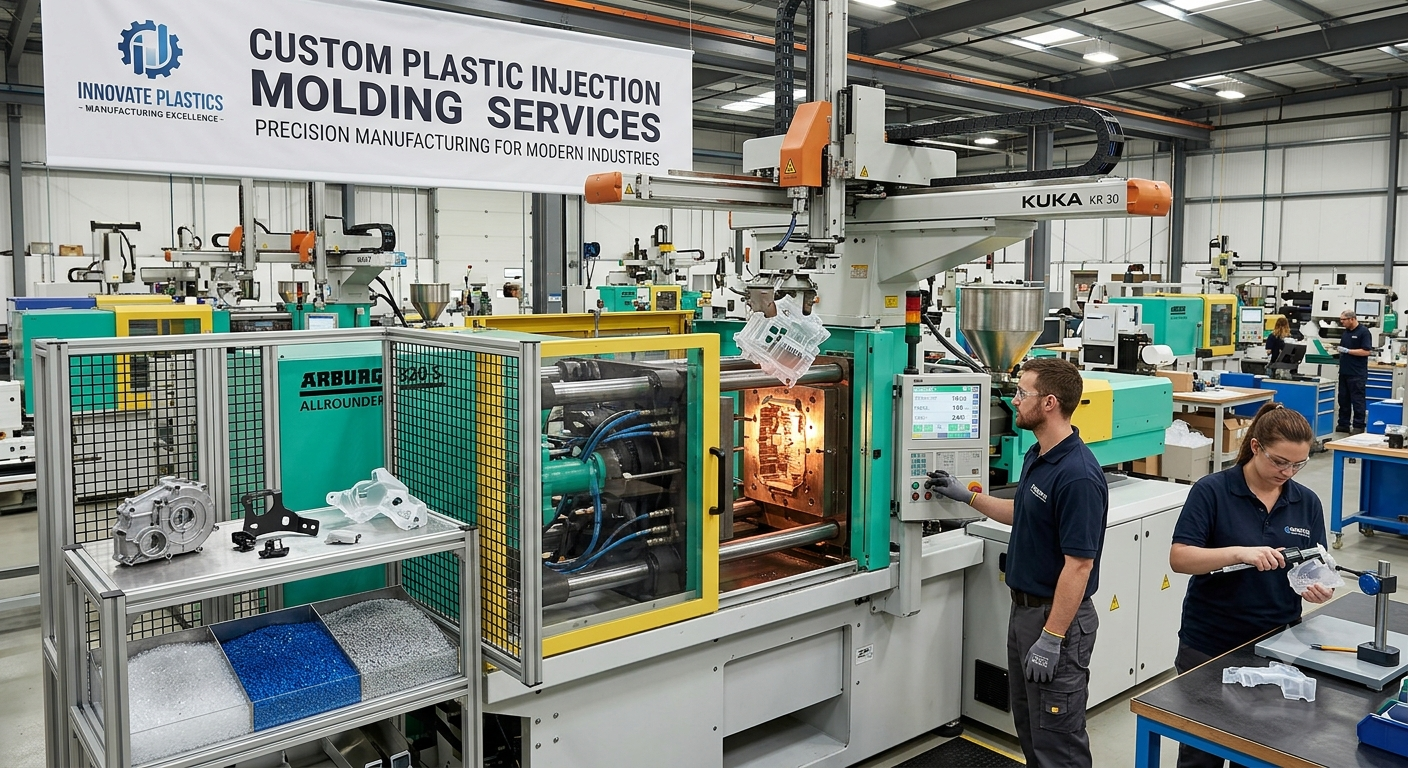


Manufacturers across a wide range of industries depend on custom plastic injection molding services to produce durable, consistent, and highly accurate components. Companies like Plastic Molded Concepts (PMC) demonstrate the value of working with an experienced partner by delivering precision-engineered plastic parts for demanding applications. As an ISO 9001:2015 certified company with 50 years of experience, PMC specializes in high-precision injection molding, overmolding, and insert molding for industries including aerospace, medical, and electronics. Their comprehensive capabilities also include mold design, material selection, prototype development, forensic failure analysis, and secondary operations, enabling customers to receive reliable, high-quality plastic components tailored to their exact specifications.
What Is Custom Plastic Injection Molding?
Custom plastic injection molding is a manufacturing process in which molten plastic is injected into a precisely engineered mold cavity under high pressure. Once cooled and solidified, the molded part is ejected, resulting in a component with excellent dimensional accuracy and repeatability.
Unlike off-the-shelf plastic products, custom molding allows manufacturers to create parts with unique geometries, specialized materials, and application-specific performance characteristics. This process supports everything from simple consumer products to highly engineered components used in life-critical medical equipment and aerospace assemblies.
Working with an experienced plastic injection molding manufacturer ensures that every stage of production—from concept to final inspection—is optimized for quality, efficiency, and long-term performance.
Why Precision Matters
Precision is one of the greatest advantages of injection molding. Even the smallest dimensional inconsistencies can affect assembly, functionality, and product reliability.
Modern manufacturers invest in advanced molding equipment, quality management systems, and engineering expertise to maintain tight tolerances throughout production. This is especially important in industries such as:
- Medical device manufacturing
- Aerospace engineering
- Electronics production
- Automotive components
- Industrial equipment
- Consumer products
High-precision molding minimizes waste, improves product consistency, and reduces costly manufacturing errors.
Choosing the Right Material
Material selection plays a critical role in determining the durability, flexibility, chemical resistance, and strength of a molded component.
Manufacturers evaluate several factors before selecting a resin, including:
- Operating temperature
- Mechanical strength
- UV resistance
- Chemical exposure
- Wear resistance
- Regulatory requirements
One commonly used material is resin hdpe, valued for its excellent impact resistance, moisture resistance, durability, and cost-effectiveness. HDPE is frequently selected for industrial products, medical containers, fluid handling components, and consumer goods because it performs well in demanding environments while remaining lightweight.
An experienced engineering team helps customers select the ideal material for each application, ensuring long-term product reliability.
Advanced Injection Molding Capabilities
Today’s manufacturers offer far more than traditional molding services. Advanced production facilities provide a complete manufacturing solution that includes specialized molding processes and engineering support.
High-Precision Injection Molding
High-precision molding focuses on producing components with extremely tight tolerances and consistent dimensions across large production runs. This capability is essential for products where even slight variations could affect performance.
Overmolding
Overmolding combines two or more materials into a single finished product. This process is commonly used to create ergonomic grips, protective coatings, vibration-dampening surfaces, and multi-material assemblies.
Benefits include:
- Improved product durability
- Better user comfort
- Reduced assembly costs
- Enhanced appearance
- Increased product functionality
Insert Molding
Insert molding incorporates metal or other components directly into the molded plastic during manufacturing.
Common insert materials include:
- Brass inserts
- Steel components
- Threaded fasteners
- Electrical contacts
Insert molding improves structural integrity while eliminating secondary assembly steps.
Engineering Support Beyond Manufacturing
The most valuable manufacturing partners contribute far more than production capacity. Engineering expertise can significantly improve product performance while reducing manufacturing costs.
Professional engineering services often include:
Mold Design
Effective mold design determines part quality, cycle time, production efficiency, and manufacturing cost. Experienced mold designers optimize cooling channels, gate locations, venting, and ejection systems to maximize production performance.
Material Selection
Choosing the appropriate polymer requires balancing mechanical properties, environmental resistance, regulatory compliance, and cost considerations.
Manufacturers work closely with customers to identify materials that meet both performance and budget requirements.
Prototype Development
Prototype development allows engineers to evaluate designs before investing in full-scale production tooling.
Prototypes help verify:
- Part functionality
- Dimensional accuracy
- Material performance
- Assembly compatibility
- Manufacturing feasibility
Early testing reduces project risks and shortens development timelines.
Forensic Failure Analysis
When plastic components fail unexpectedly, forensic failure analysis identifies the underlying causes.
Engineering teams examine factors such as:
- Material degradation
- Excessive stress
- Environmental exposure
- Design flaws
- Manufacturing defects
These findings help manufacturers improve future designs and prevent recurring failures.
Secondary Operations
Many molded components require additional processing after molding.
Common secondary operations include:
- Assembly
- Ultrasonic welding
- Heat staking
- Pad printing
- Laser marking
- Machining
- Packaging
- Inspection
Offering these services under one roof simplifies production while reducing lead times.
Industries That Benefit from Injection Molding
Custom injection molding supports countless industries requiring consistent quality and high-volume production.
Aerospace
Aerospace applications demand lightweight, durable components capable of withstanding extreme operating conditions. Precision plastic parts contribute to reduced aircraft weight while maintaining exceptional strength and reliability.
Medical
Medical manufacturers require strict quality control, regulatory compliance, and repeatable manufacturing processes. Injection molding produces components used in diagnostic devices, laboratory equipment, surgical instruments, and medical enclosures.
Electronics
Electronic products rely on molded housings, connectors, insulators, and protective enclosures. Tight tolerances ensure reliable assembly while specialized materials provide electrical insulation and thermal resistance.
Industrial Equipment
Industrial machinery incorporates molded components for fluid handling, equipment protection, controls, and mechanical assemblies that must withstand demanding operating environments.
Quality Assurance Makes the Difference
Quality management systems are essential for maintaining consistent production standards.
An ISO 9001:2015 certified manufacturer follows documented procedures for:
- Process control
- Inspection
- Equipment calibration
- Risk management
- Continuous improvement
- Customer satisfaction
These practices help ensure every production run meets customer specifications while maintaining traceability throughout manufacturing.
Benefits of Working with an Experienced Manufacturer
Partnering with an established plastic injection molding manufacturer offers numerous advantages beyond simply producing plastic parts.
These benefits include:
- Decades of manufacturing expertise
- Engineering consultation
- Material recommendations
- Consistent product quality
- Reduced production costs
- Faster product development
- Improved manufacturing efficiency
- Scalable production capabilities
- Comprehensive quality control
- Complete project management
Long-term manufacturing partners become valuable contributors throughout the entire product lifecycle.
Sustainability in Plastic Manufacturing
Modern injection molding companies increasingly focus on sustainable manufacturing practices.
Common initiatives include:
- Material recycling
- Reduced production waste
- Energy-efficient equipment
- Optimized production cycles
- Environmentally responsible material selection
Efficient manufacturing not only benefits the environment but also helps reduce overall production costs.
Conclusion
Custom plastic injection molding remains one of the most efficient and reliable manufacturing methods for producing high-quality plastic components across virtually every major industry. Whether manufacturing medical devices, aerospace components, electronic housings, or industrial equipment, precision engineering and experienced production capabilities are essential for achieving consistent results.
Companies like Plastic Molded Concepts (PMC) demonstrate how decades of expertise, ISO 9001:2015 certification, and comprehensive engineering support create long-term value for customers. From mold design and prototype development to material selection, forensic failure analysis, overmolding, insert molding, and secondary operations, experienced manufacturers deliver complete solutions that help businesses produce durable, accurate, and dependable products. By selecting the right materials—including options such as resin hdpe—and partnering with a trusted plastic injection molding manufacturer, organizations can improve product quality, streamline production, and confidently bring innovative products to market.